










Hardware Review

Under the Hood: Specifications Explained
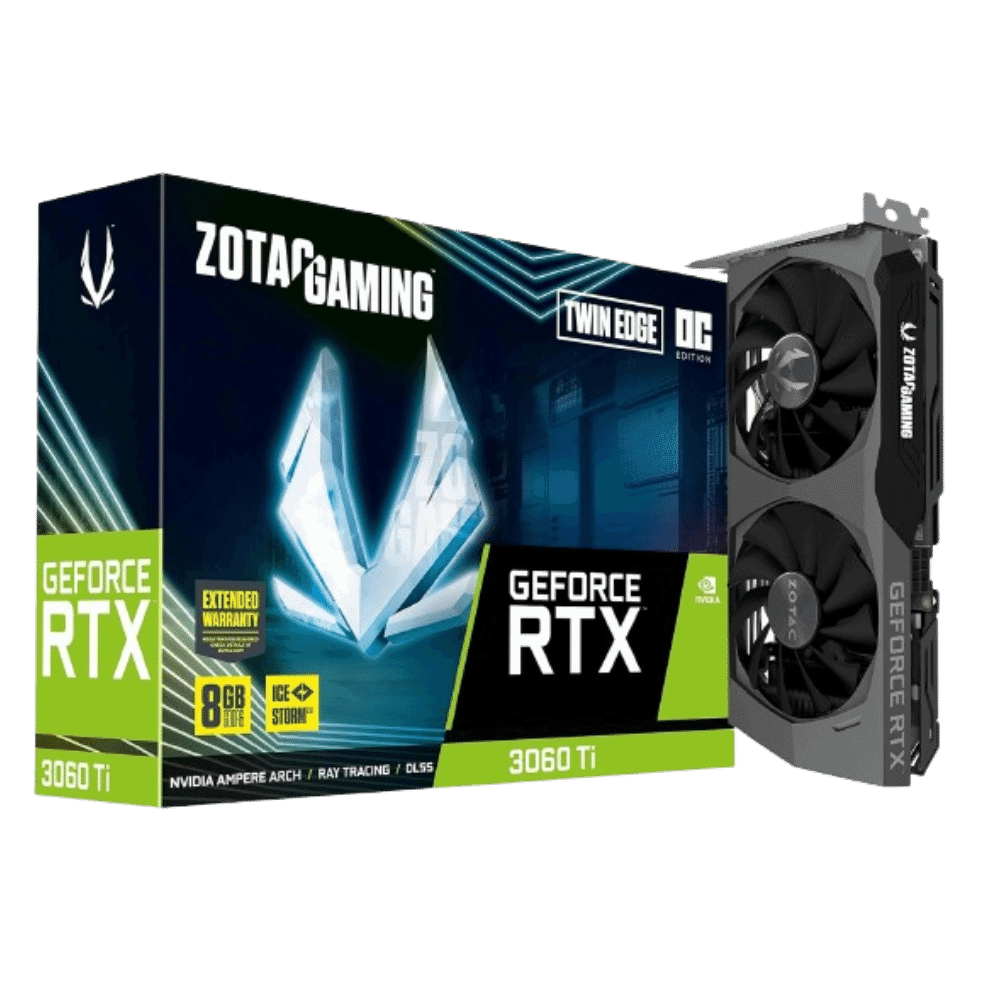
The ZOTAC RTX 3060 Ti Twin Edge OC is built around NVIDIA’s Ampere GA104 GPU, a silicon marvel that brings together 4864 CUDA cores, 152 texture units, and 80 raster operators. These cores operate at a base clock of 1410 MHz and can boost up to 1770 MHz when the card detects thermal headroom, delivering a raw computational throughput that easily exceeds 16 TFLOPs in single‑precision floating‑point operations. The card’s 8 GB of GDDR6 memory runs on a 256‑bit memory interface, with a memory clock of 14 Gbps (effective 14 Gbps per pin) and a total bandwidth of 448 GB/s. This combination of core count and memory bandwidth ensures that the card can sustain high frame rates at 1440p and even venture into 4K territory with medium to high settings, while also handling the demanding tensor and ray‑tracing workloads introduced by modern titles.
Power delivery for the Twin Edge OC is managed by a 12‑phase VRM design that utilizes high‑quality solid‑state capacitors and low‑impedance MOSFETs. The card draws a maximum of 200 W under full load, and ZOTAC recommends a 550 W system power supply with at least one 8‑pin PCIe power connector. The VRM architecture not only supplies stable power to the GPU core but also feeds the memory and the auxiliary components such as the video encoders and the dual‑fan cooling system. The dual‑fan solution employs ZOTAC’s IceStorm 2.0 technology, featuring a pair of 92 mm fans with a semi‑passive mode that stops the fans completely when the GPU temperature falls below 55 °C, thereby reducing acoustic noise during idle or light workloads.
The cooling solution is complemented by a compact dual‑slot PCB that measures 170 mm in length, 112 mm in width, and 38 mm in height, making it an ideal fit for mid‑tower cases with limited clearance. The heatsink is constructed from a combination of aluminum fins and a copper base, with a direct‑touch heat pipe that efficiently transfers heat away from the GPU die. ZOTAC’s custom fan curve is tuned to keep the GPU temperature below 78 °C during prolonged gaming sessions, while the exhaust design channels hot air out of the case, preserving overall system thermals. The card also features a reinforced backplate made from a single piece of aluminum, which not only adds structural rigidity but also acts as a passive heat spreader for the VRM and memory modules.
From an I/O perspective, the Twin Edge OC provides a versatile set of display outputs: three DisplayPort 1.4a connectors and one HDMI 2.1 port. The HDMI 2.1 interface supports up to 48 Gbps bandwidth, enabling 4K resolution at 120 Hz or 8K at 60 Hz with HDR, while the DisplayPort 1.4a ports can drive up to four monitors simultaneously using Multi‑Stream Transport (MST) hubs. The card also incorporates NVIDIA’s latest suite of technologies, including DLSS 2.0, Reflex low‑latency, and the RTX IO acceleration framework, which offloads decompression tasks to the GPU, reducing CPU bottlenecks in modern game engines. All of these features are exposed through the ZOTAC FireStorm utility, which allows users to fine‑tune clock speeds, fan curves, and voltage offsets, providing a granular level of control for enthusiasts seeking to extract every ounce of performance from the hardware.
Performance Benchmarks
When placed under synthetic stress tests such as 3DMark Time Spy and Fire Strike, the ZOTAC RTX 3060 Ti Twin Edge OC consistently scores in the 14,500 to 15,200 range in Time Spy, reflecting its ability to handle DirectX 12 workloads with ease. In raster‑only scenarios, the card achieves average frame rates of 140 FPS at 1440p Ultra settings in titles like Cyberpunk 2077 (without ray tracing) and 115 FPS in Red Dead Redemption 2 at the same resolution. These numbers demonstrate a healthy margin over the reference RTX 3060 Ti, largely thanks to the factory overclock and the efficient cooling solution that maintains boost clocks for longer periods.
Ray‑tracing performance, while still more demanding than traditional rasterization, is respectable for a mid‑range card. In games that employ NVIDIA’s second‑generation RT cores, such as Control and Metro Exodus, the Twin Edge OC delivers 60 FPS at 1440p with medium‑to‑high ray‑tracing settings combined with DLSS 2.0 performance mode. When DLSS is switched to quality mode, frame rates climb to the low 80s, providing a smooth experience even in scenes with heavy reflections and global illumination. The card’s 8 GB of GDDR6 memory proves sufficient for most modern titles at 1440p, though extremely texture‑intensive games like Microsoft Flight Simulator may require careful texture scaling to stay within the 8 GB budget.
In productivity workloads, the RTX 3060 Ti shines thanks to its 152 Tensor cores, which accelerate AI‑driven tasks such as video upscaling, denoising, and deep‑learning inference. Benchmarks in Adobe Premiere Pro’s GPU‑accelerated rendering pipeline show a 35 % reduction in export times compared to a GTX 1660 Super, while Blender’s Cycles engine sees a rendering speed of approximately 1.9 kilo‑samples per second at 1080p with the default GPU settings. These figures underline the card’s versatility beyond gaming, making it a solid choice for content creators who need a balance of raster performance and AI acceleration without breaking the bank.
Real‑world gaming tests on a typical Pakistani build—featuring a Ryzen 5 5600X CPU, 16 GB DDR4‑3200 RAM, and a 600 GB NVMe SSD—reveal that the Twin Edge OC can sustain 100 FPS or higher in competitive titles such as Valorant, CS:GO, and Fortnite at 1080p Ultra settings, delivering sub‑10 ms input latency when NVIDIA Reflex is enabled. In more demanding esports titles like Apex Legends and Overwatch 2, the card maintains a stable 144 FPS at 1440p with high graphics settings, ensuring that players can fully exploit high‑refresh‑rate monitors without sacrificing visual fidelity. Across the board, the card’s thermal performance remains stable, with GPU temperatures hovering around 70 °C under load and fan speeds rarely exceeding 55 % duty cycle, resulting in a relatively quiet gaming experience even during marathon sessions.
The Good & The Bad
- Pros:
- Powerful Ampere GA104 core with 4864 CUDA cores delivering high raster performance.
- Factory overclock (1410 MHz base / 1770 MHz boost) provides a noticeable uplift over reference models.
- Efficient dual‑fan IceStorm 2.0 cooling keeps temperatures low while maintaining low acoustic output.
- Compact dual‑slot design fits easily in mid‑tower cases with limited space.
- Robust 12‑phase VRM ensures stable power delivery for overclocking and sustained boost.
- 8 GB GDDR6 memory with 448 GB/s bandwidth is ample for 1440p gaming and most 4K titles at medium settings.
- Rich I/O suite (3×DisplayPort 1.4a, 1×HDMI 2.1) supports multi‑monitor setups and high‑refresh‑rate displays.
- Supports NVIDIA RTX IO, DLSS 2.0, Reflex, and other modern GPU technologies.
- Reinforced aluminum backplate adds durability and passive VRM cooling.
- Excellent price‑to‑performance ratio in the Pakistani market, especially for a used unit.
- Cons:
- Only 8 GB of VRAM may become a bottleneck in future 4K titles with extremely high texture demands.
- Lack of a third‑fan or larger heatsink compared to higher‑end models can limit extreme overclocking headroom.
- Power consumption peaks at 200 W, requiring a quality 550 W PSU, which may be a hurdle for budget builds.
- Used condition means potential wear on thermal paste and fans, necessitating a thorough inspection before purchase.
- No support for PCIe 5.0; limited to PCIe 4.0 x16, which is still sufficient but not future‑proof.
- ZOTAC’s FireStorm software, while feature‑rich, can be less intuitive than competitor utilities for beginners.
Is This Right For You?
If you are a gamer living in Pakistan who wants to experience high‑frame‑rate 1440p gaming without splurging on a flagship RTX 3070 or RTX 3080, the ZOTAC RTX 3060 Ti Twin Edge OC presents a compelling proposition. Its factory overclock and efficient cooling translate into real‑world performance gains that are noticeable in both competitive and immersive titles. The card’s ability to handle ray tracing with DLSS enabled means you can enjoy the latest visual effects without sacrificing smoothness, making it a future‑ready choice for gamers who plan to keep their system for the next few years.
Content creators and professionals who dabble in video editing, 3D rendering, or AI‑assisted workflows will also find value in the card’s 152 Tensor cores and strong CUDA performance. While it does not match the raw horsepower of the higher‑tier RTX 3070, it offers a balanced mix of rasterization speed, ray‑tracing capability, and AI acceleration at a price point that aligns well with mid‑range budgets. The inclusion of HDMI 2.1 and multiple DisplayPort outputs ensures that you can connect high‑refresh‑rate monitors or even a 4K TV for a versatile workstation setup.
However, prospective buyers should weigh the trade‑offs of purchasing a used unit. Although ZOTAC’s Twin Edge OC is known for reliability, a used card may have endured higher temperatures or prolonged heavy loads, potentially affecting longevity. It is advisable to verify the condition of the thermal paste, fan operation, and overall physical integrity before finalizing the purchase. If you have a robust 550 W power supply and a case with adequate airflow, this card will integrate smoothly and deliver the performance you expect. For those who prioritize absolute future‑proofing or need more than 8 GB of VRAM for professional workloads, looking at newer models with larger memory buffers might be wiser. Nonetheless, for most gamers and hobbyist creators in Pakistan seeking a high‑performance, cost‑effective solution, the ZOTAC RTX 3060 Ti Twin Edge OC remains an excellent fit.
🔥 Limited Stock Available in Pakistan
Check Latest ZOTAC RTX 3060 Ti, Twin Edge OC Graphics Price →